Search
TASTING
Traditional Dishes
Typical dishes to accompany your visit


The local food and wine heritage of Valsesia and its hills is rich in local delicacies: traditional dishes that tell the story of our land’s rural and pastoral past.
Once considered “poor man’s food”; now a true treasure for everyone who savors them.
Local ingredients and flavors from the past
Miaccia
Considered one of the most important gastronomic specialties of Valsesia, miaccia originated in the sixteenth century when millet flour was used to make its ancestor, the migliaccio.
Over time, its recipe has changed and been passed down orally, resulting in various versions of this crunchy wafer (not to be confused with a crêpe!) which today is a symbol of celebration and togetherness.
The most common recipe uses flour, milk, cream, and a pinch of salt, but in the side valleys you may also find the use of eggs and, in some cases, cornmeal.
One thing, however, is certain and universally recognized: miaccia must be cooked in its special iron—two hinged iron discs attached to a long handle, which allows this delicacy to be cooked directly over the fire.
At this point, only the filling is missing: the classic has just a spread of butter and salt, but the most delicious versions also add toma cheese, wild thyme (saleggia), and local cured meats. The sweet version with honey, butter and sugar, creams, and jams, is also delightful.
Photo credit: miaccia iron: alagna.it

.jpg?v=1.0)
Paniccia, Paniscia and Panissa
One destination, two provinces and three dishes that are similar but never identical.
Paniscia is a typical risotto from the Novara area made with vegetables and salam d'la Duja (a local cured sausage).
Panissa is its Vercelli cousin, less rich in vegetables but heartier with more meat.
Paniccia is the Valsesian interpretation: a soup with rice or pasta served at Carnival. Every year, squares fill with rows of cauldrons brimming with this soup, ready to be shared with the community.
.jpg?v=1.0)
Credits © Comitato Carnevale Varallo
Credits © Comitato Carnevale Varallo
Ava coccia and capuneit
If there is a dish that represents the evening meal of mountain people from long ago, it is "acqua cotta": a simple broth of butter, whatever vegetables were available, and bread. If luck allowed, a slice of toma cheese or leftover polenta could be added. Over time, it also became a remedy after overindulgence the evening before, and today it is prepared in families as a reminder of the old times.
Another typical, but richer, dish is capuneit: a kind of roll made from Swiss chard leaves (or cabbage or lavassa), stuffed with stale bread, salami paste, butter, and thyme.
Walser Flavors: Wallischuppa and D'Land Turta
Necessity is the mother of invention: Wallischuppa was created for two main reasons: first, to warm up after a long cold day, and second, to soften hardened rye bread. This soup, made with bread, onion, bacon, butter, toma cheese, cinnamon, and a touch of sugar, is ideal for connecting with Walser culture.
D'Land Turta – also called Torta di Alagna – is another very rich Walser delicacy: a rustic cake made of wheat and corn flour, cream, butter, sugar, red wine, milk, salami, toma cheese, apples, dried figs, and raisins. A hearty, energy-rich dish perfect to recharge after long mountain hikes.
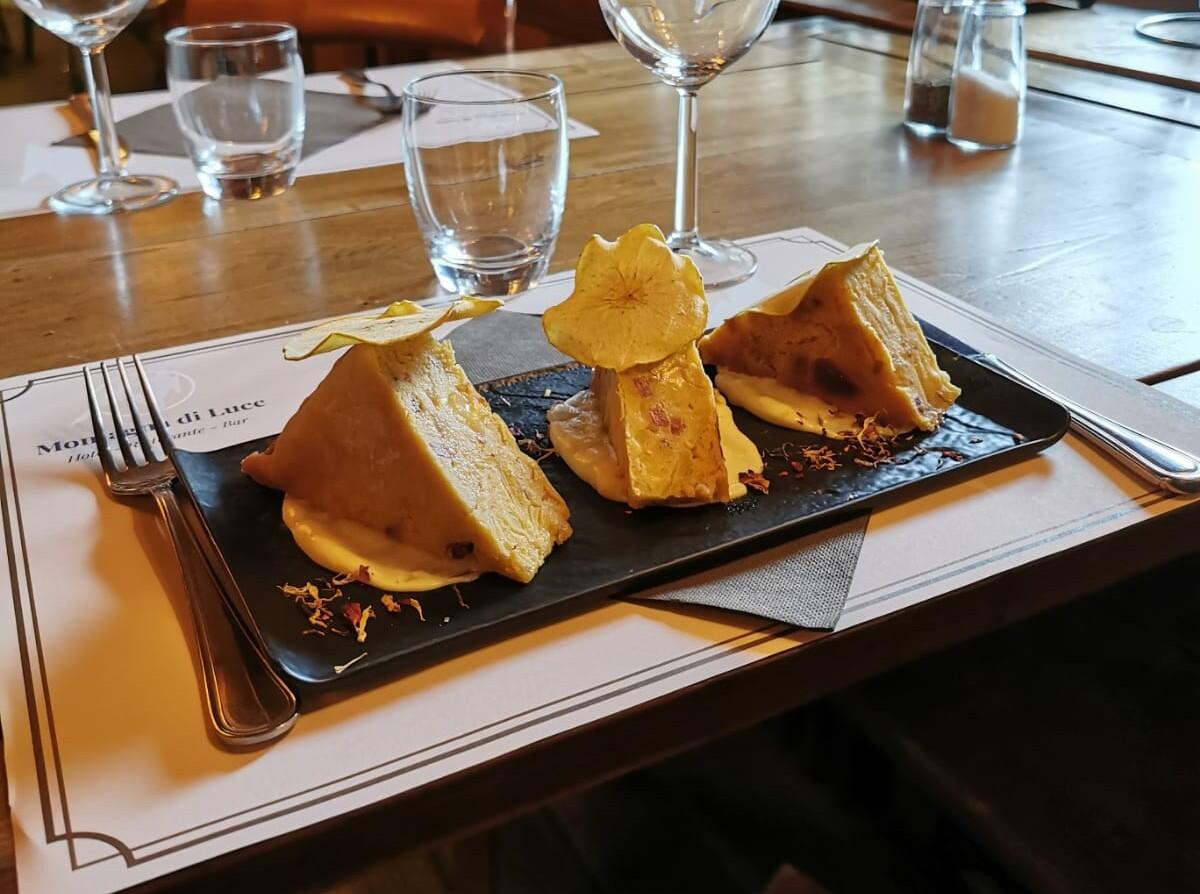
Credits © Montagna di Luce - chef Alberto Pollet
Credits © Montagna di Luce - chef Alberto Pollet
A dish that unites hills and mountains: Frità rugnosa
Few recipes evoke spring and the joy of Easter picnics as much as Frità rugnosa.
The ingredients are simple: eggs (of course), diced salam d'la duja, Grana Padano cheese, and your choice of aromatic herbs (parsley or saleggia, wild thyme, are recommended).
A flavorful dish, perfect for springtime outings.
.jpg?v=1.0)


Fondo europeo agricolo di sviluppo rurale.
L'Europa investe nelle zone rurali.
PSR 2014 - 2020, Misura 19 - op. 7.5.2 tipologia 2
Infrastrutture turistico-ricreative ed informazione nell’ambito del CCLD LEADER - Informazione
